
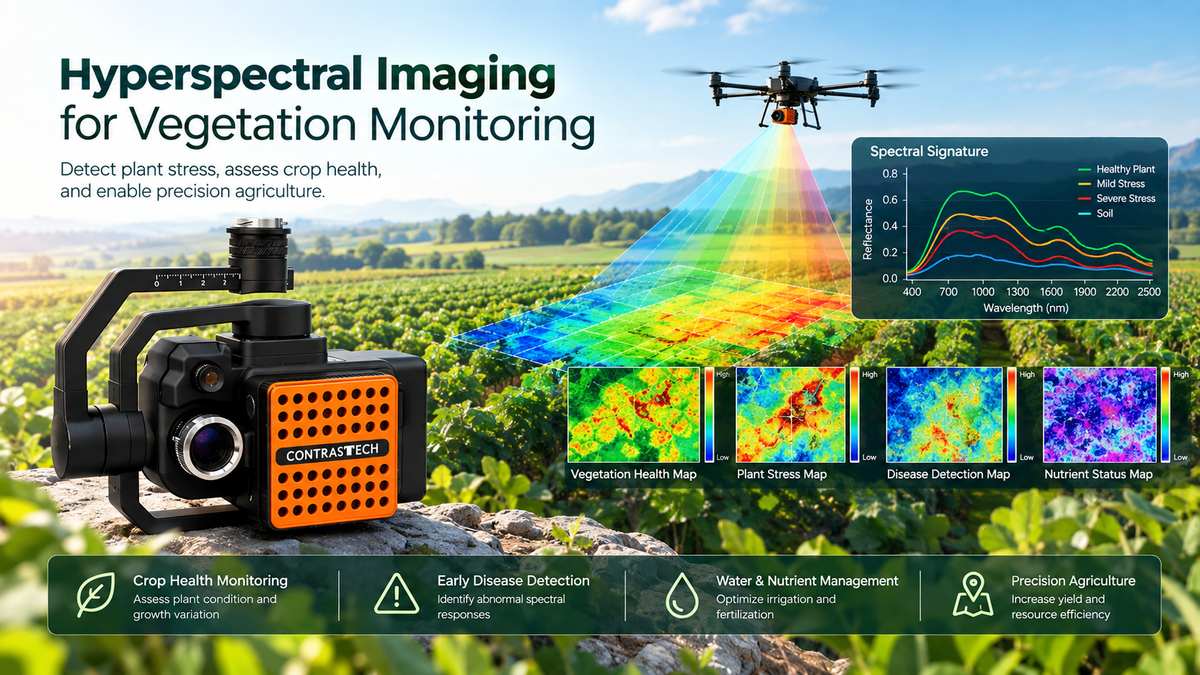
Hyperspectral Imaging for Vegetation Monitoring: Detecting Plant Stress, Disease and Crop Health
Discover how hyperspectral cameras reveal subtle spectral differences in plants for crop monitoring, stress detection, plant research and precision agriculture.

Why Look Beyond the Visible Image?
A conventional RGB camera can show leaf color, shape and visible damage. However, some changes in plant condition may occur before obvious visual symptoms appear.
Hyperspectral imaging captures detailed spectral information across many narrow wavelength bands. These measurements allow researchers to analyze how plants respond to different wavelengths and identify subtle spectral differences associated with plant condition.
As a result, hyperspectral cameras can support applications such as crop health monitoring, plant stress analysis, disease research, vegetation classification and precision agriculture.
Understanding Plant Spectral Signatures
Vegetation has characteristic spectral behavior across the visible, near-infrared and short-wave infrared regions. The spectral response changes according to plant structure, pigments, water content and other biological characteristics.
| Spectral Region | Typical Information | Vegetation Applications |
|---|---|---|
| 400–700 nm | Visible spectral response and plant pigments | Vegetation classification and plant research |
| 700–1000 nm | Strong vegetation-related spectral response | Crop monitoring and vegetation mapping |
| 900–1700 nm | NIR-SWIR plant material characteristics | Plant research and stress-related analysis |
| 1400–2500 nm | Detailed SWIR spectral information | Advanced vegetation and material research |
The appropriate wavelength range depends on the application. For basic vegetation classification and crop monitoring, VNIR coverage may be sufficient. Applications requiring broader spectral information can benefit from NIR-SWIR or full VNIR-SWIR systems.
Key Applications of Hyperspectral Imaging in Vegetation Monitoring
1. Crop Health Monitoring
Hyperspectral imaging provides more information than conventional color imaging for analyzing crop conditions. Spectral data can be used to distinguish differences between plants and support monitoring of crop development and health.
This makes hyperspectral cameras useful for agricultural research, crop phenotyping and field monitoring.
2. Plant Stress and Disease Research
Changes in plant physiology can affect spectral response. Hyperspectral imaging can therefore be used to identify abnormal spectral patterns and support research into plant stress and disease.
Potential research areas include:
- Plant disease screening
- Stress classification
- Plant health assessment
- Plant phenotyping
- Crop protection research
Hyperspectral imaging should be considered a tool for spectral analysis and early screening, rather than a replacement for biological or laboratory diagnosis.
3. Water and Nutrient Stress Monitoring
Water availability and nutrient conditions can influence plant physiology and spectral response. Hyperspectral imaging can help researchers identify spectral differences between healthy and stressed vegetation.
Combined with appropriate calibration, spectral analysis and reference datasets, hyperspectral imaging can support research into irrigation management, nutrient conditions and crop stress.
4. Precision Agriculture
Hyperspectral imaging can transform spectral information into spatial crop-condition maps. This provides a foundation for more targeted agricultural management.

UAV Hyperspectral Imaging for Large-Area Vegetation Monitoring
A hyperspectral camera mounted on a UAV can extend vegetation monitoring from individual plants and laboratory experiments to large agricultural fields, forests and remote environments.
UAV → Hyperspectral Camera → Field Survey → Spectral Analysis → Vegetation Map
UAV hyperspectral imaging can support applications including crop field monitoring, vegetation classification, agricultural remote sensing, forestry research and environmental monitoring.
Choosing the Right Hyperspectral Camera for Vegetation Monitoring
Camera selection should be based on the target spectral features, required spatial resolution, acquisition platform and whether the system will be used in laboratory, field or UAV environments.
iRb10U19L
400–1000 nm | VNIR Hyperspectral Camera
Suitable for vegetation classification, crop monitoring, plant research and applications focused on the visible and near-infrared spectral region.
Explore VNIR Hyperspectral Cameras →iRx10U19L
400–1000 nm | UAV Hyperspectral Camera
Designed for UAV-based hyperspectral imaging, providing a compact solution for vegetation monitoring, agricultural remote sensing and large-area field surveys.
Explore UAV Hyperspectral Cameras →iRb17U12A
900–1700 nm | NIR-SWIR Hyperspectral Camera
Suitable for plant and vegetation research requiring spectral information beyond the visible and traditional VNIR range.
View NIR-SWIR Solutions →iRb25VU06L
400–2500 nm | Full VNIR-SWIR Coverage
For research applications requiring broader spectral information across visible, NIR and SWIR wavelengths.
Explore Full-Range Hyperspectral Cameras →From Plant Spectra to Vegetation Maps
A typical hyperspectral vegetation monitoring workflow can combine image acquisition, spectral preprocessing and classification to transform raw hyperspectral data into actionable information.
01 — Capture
Collect hyperspectral images across the selected wavelength range.
02 — Calibrate
Apply appropriate radiometric and spectral correction.
03 — Extract
Identify relevant spectral features and vegetation signatures.
04 — Classify
Separate vegetation types, conditions or spectral classes.
05 — Map
Generate spatial vegetation or crop-condition maps.
06 — Analyze
Support agricultural, ecological or plant research decisions.
Applications Across Agriculture and Vegetation Research
Build Your Vegetation Imaging Solution
From VNIR crop monitoring to NIR-SWIR plant research and UAV-based vegetation surveys, choose the wavelength range and camera configuration that fits your application.
Explore Hyperspectral Cameras